Introduction
A reliable flashlight is one of those simple pieces of equipment that can become extremely useful when visibility is limited. At home, a flashlight can help during a power outage or when looking for something in a dark storage area. Outdoors, it can assist with walking around a campsite, checking equipment after sunset, finding a trail, or navigating around a vehicle at night. In an emergency, having a compact light source available can become an important part of a broader preparedness kit.
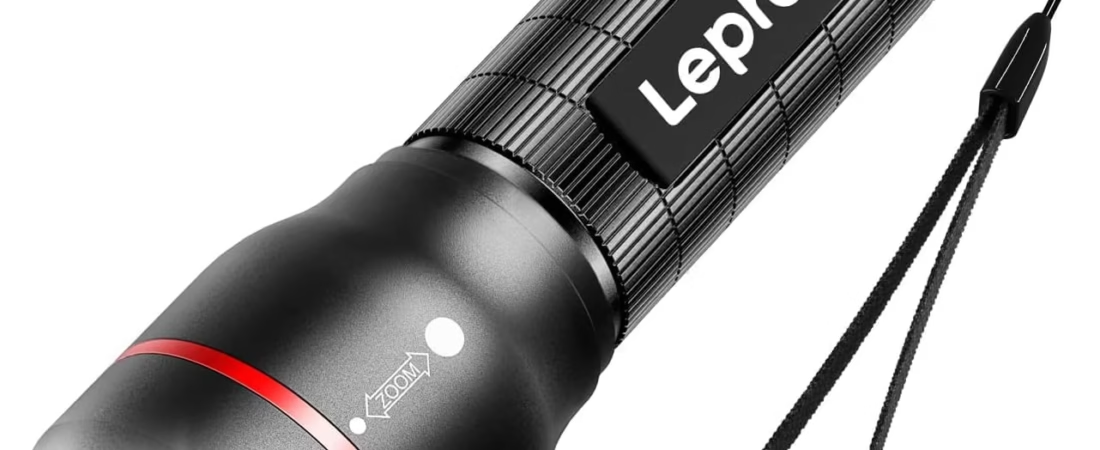
The Lepro LED Flashlight LE2000 is designed as a compact, portable flashlight for everyday and outdoor applications. Its listed features include a high-lumen output, five lighting modes, adjustable zoom, a waterproof-oriented design, pocket-size construction, and operation using AAA batteries.
These characteristics place it within a category of flashlights designed to balance portability with versatility. Instead of carrying a large lantern or specialized lighting system, users can keep a small flashlight in a pocket, backpack, drawer, vehicle, or camping kit.
The usefulness of a flashlight, however, is not determined by brightness alone. Beam pattern, battery type, runtime, physical size, weather resistance, controls, and the environment in which the flashlight will be used all matter. A light that is extremely bright but difficult to operate or inconvenient to carry may not be suitable for every situation.
This guide takes a closer look at the practical role of the Lepro LE2000 and similar compact LED flashlights. It explains the meaning of common flashlight features, explores potential uses, discusses important considerations, and compares several general flashlight categories without treating one type as universally appropriate for everyone.
Key Features
High-Lumen LED Output
One of the main characteristics highlighted for the Lepro LE2000 is its high-lumen light output.
Lumens are a measurement of the total amount of visible light produced by a light source. In flashlight specifications, a higher lumen figure generally indicates greater overall light output.
However, lumen numbers should not be viewed as the only indicator of practical performance.
Two flashlights with similar lumen ratings can produce noticeably different results depending on reflector design, lens construction, beam shape, LED configuration, and how the light is distributed.
For practical use, it is often more useful to think about what type of illumination is required. A wide beam can be helpful for illuminating an immediate campsite, while a more concentrated beam can make distant objects easier to see.
The LE2000’s multiple modes and adjustable zoom are designed to give users more control over how the available light is used.
Five Lighting Modes
The flashlight is designed with five lighting modes.
Multiple modes can make a flashlight more adaptable because different situations require different levels or patterns of illumination.
For example, a lower setting can be useful when reading a map, looking inside a tent, or moving around a room without needing maximum brightness. A higher setting can provide more illumination when walking outdoors or examining a larger area.
Having several modes can also allow users to balance brightness and battery consumption.
The exact behavior of each mode depends on the product’s configuration, so users should familiarize themselves with the controls before taking the flashlight on an important trip.
Adjustable Zoom
A zoomable flashlight allows the beam to be adjusted.
Rather than producing one fixed beam pattern, the optical assembly can be moved to change the concentration of the light.
A broader beam can illuminate a wider area close to the user. A more concentrated beam can direct more of the available light toward a smaller area farther away.
This flexibility can be useful when moving between indoor and outdoor environments.
For example, a camper may want broad illumination while organizing equipment around a tent and a narrower beam when looking farther along a path.
Beam adjustment is therefore less about making the flashlight universally brighter and more about controlling how the light is distributed.
Compact Pocket-Size Design
Portability is another important characteristic.
A pocket-sized flashlight can be carried regularly without requiring a dedicated equipment bag.
This makes it suitable for keeping in places where quick access matters, including:
- Jacket pockets
- Backpacks
- Camping bags
- Desk drawers
- Vehicle compartments
- Emergency kits
- Tool bags
- Bedside storage
A compact flashlight can also serve as a backup light when larger lighting equipment is unavailable.
AAA Battery Operation
The Lepro LE2000 is designed to operate using AAA batteries.
Battery choice affects convenience and maintenance.
AAA batteries are widely available and can be stored as spare power sources. This can be useful for emergency preparedness because users do not necessarily need access to a proprietary charging system.
Battery-powered equipment can also be practical for long-term storage. A flashlight can be stored with spare batteries and used when needed.
Users should follow the manufacturer’s recommendations regarding battery type, installation, and storage. If a flashlight will remain unused for an extended period, checking the batteries periodically can help reduce the risk of leakage or unexpected loss of power.
Waterproof-Oriented Construction
The flashlight is described as waterproof, which can be useful for outdoor activities.
Weather-resistant construction can provide additional protection when a flashlight is exposed to rain, splashes, or damp environments.
However, the word “waterproof” should not automatically be interpreted as meaning that the flashlight can be submerged indefinitely or used underwater.
Water-resistance classifications, when provided, offer more specific information about what a product is designed to withstand.
For ordinary outdoor use, the practical benefit is having a flashlight that is less vulnerable to weather exposure than a device designed strictly for dry indoor environments.
How It Can Be Used
Camping
Camping is one of the most obvious applications for a compact flashlight.
Once the sun goes down, even a familiar campsite can become difficult to navigate. A flashlight can help illuminate tent entrances, equipment, pathways, cooking areas, and nearby surroundings.
The adjustable beam can be useful in different parts of the campsite. A broader setting can illuminate an immediate area, while a narrower beam can help direct light farther ahead.
Keeping a flashlight within easy reach inside a tent is also practical. It can be useful if someone needs to leave the tent during the night.
Hiking
A compact flashlight can be part of a hiking or backpacking safety kit.
Day hikes can sometimes take longer than expected, and changing weather or route conditions can delay a return before sunset.
Carrying a flashlight provides an additional source of illumination if daylight disappears.
For hiking, weight and size are particularly relevant. A pocket-size flashlight can be easier to include in a small backpack or jacket pocket than a larger lantern.
A flashlight should complement, rather than replace, proper route planning, navigation equipment, and awareness of local conditions.
Emergency Preparedness
A flashlight is a common component of emergency kits because many emergency situations involve power interruptions or reduced visibility.
During a household power outage, a flashlight can provide localized illumination without requiring candles or other open flames.
It can also be kept in an emergency backpack, vehicle kit, or workplace drawer.
For preparedness, the battery system is particularly important. Keeping spare compatible batteries with the flashlight can help ensure that the light remains usable when needed.
Power Outages
During an electrical outage, finding a flashlight in complete darkness can be surprisingly difficult.
For that reason, households often benefit from storing flashlights in consistent and easily accessible locations.
A compact flashlight such as the LE2000 can be placed in a bedside drawer, kitchen cabinet, hallway storage area, or emergency supply container.
It is useful to establish a habit of returning the flashlight to the same location after use.
Road Trips
A flashlight can also be useful during road travel.
If a vehicle stops in an area with limited lighting, a handheld flashlight can help inspect the immediate surroundings or locate equipment inside the vehicle.
It can also be included in a roadside emergency kit.
When using a flashlight near traffic, users should remember that visibility to other drivers is important. A flashlight is an illumination tool, not a substitute for appropriate roadside warning equipment.
Home Maintenance
Compact flashlights are useful even without an emergency.
Dark spaces beneath furniture, inside cabinets, behind appliances, and around storage areas can be difficult to illuminate with ordinary room lighting.
A handheld flashlight allows the user to direct light precisely where it is needed.
The multiple modes can also be useful when working in different environments.
Outdoor Recreation
Fishing, hiking, camping, photography, wildlife observation, and other outdoor activities can involve low-light conditions.
A compact flashlight can serve as a general-purpose illumination tool.
Users should always consider whether the activity has specific requirements for light color, intensity, or signaling.
Who It May Be Suitable For
Campers
Campers can benefit from having a dedicated handheld light in addition to lanterns or headlamps.
A flashlight provides directional illumination and can be useful when moving around the campsite.
Hikers
Hikers who want a compact backup light may find a pocket-sized flashlight practical.
It can be stored in a jacket pocket or backpack compartment without taking up much space.
Families
A flashlight can be useful for household emergency preparedness.
Families may choose to keep multiple flashlights in different locations so that everyone has access to a light source during a power outage.
Drivers
People who spend considerable time on the road can keep a flashlight in their vehicle emergency kit.
A dedicated flashlight can be useful during nighttime roadside situations, particularly when the surrounding area has limited lighting.
Travelers
Travelers can use compact flashlights in hotels, campsites, cabins, outdoor areas, and other unfamiliar environments.
Because the device is small, it can usually be stored without significantly affecting luggage organization.
Emergency Preparedness Users
Anyone assembling an emergency kit may consider a battery-powered flashlight a practical addition.
Its usefulness does not depend on a particular emergency scenario. Power failures, nighttime evacuations, roadside problems, and outdoor delays can all create situations where portable lighting is valuable.
Important Things to Consider
Brightness Is Not Everything
It is easy to focus on lumen numbers when comparing flashlights.
Brightness is important, but it is only one part of the equation.
Beam distance, beam width, runtime, controls, battery capacity, heat management, and physical design can all affect practical usefulness.
A very bright beam may not be necessary for reading, indoor use, or walking around a campsite.
Battery Runtime
Battery life depends on the selected lighting mode and the batteries being used.
Higher output generally requires more electrical power.
This is one reason multiple lighting modes can be useful. A lower mode may provide enough illumination for simple tasks while conserving battery energy.
Users should consider carrying spare AAA batteries during longer trips.
Battery Storage
If the flashlight will be stored for a long period, battery maintenance matters.
Batteries can eventually lose charge or, under certain conditions, leak.
Follow the manufacturer’s recommendations for storage and battery removal.
For emergency kits that may remain untouched for months, periodically inspecting batteries and testing the flashlight is a sensible maintenance practice.
Waterproofing and Weather Resistance
A flashlight described as waterproof may be better suited to outdoor environments, but users should still understand the limits of the product.
Heavy rain, accidental drops into water, and complete submersion are different situations.
If the manufacturer provides an ingress-protection rating, that information should be used to understand the intended level of water exposure.
Heat From High Output
High-output LEDs can produce heat.
Depending on the design and selected mode, the flashlight may become warm during extended operation.
Users should avoid placing an operating high-output flashlight against materials that could be damaged by heat and should follow the manufacturer’s operating guidance.
Beam Pattern
A narrow beam and a broad beam serve different purposes.
A narrow beam can concentrate light toward a distant location, while a broad beam can illuminate a wider nearby area.
The zoom function can be useful because it gives the user more control over this trade-off.
Ergonomics and Controls
A flashlight needs to be easy to operate when the user cannot see the controls clearly.
Before taking it on a camping trip, it can be helpful to learn how the mode-switching system works.
Knowing how to turn the flashlight on, change modes, and turn it off without looking at it can be useful during nighttime situations.
Size Versus Capability
A compact flashlight is convenient, but smaller dimensions can also limit physical battery capacity, cooling surface area, or other design features.
Users should choose based on the intended application rather than assuming that smaller is always better.
Understanding Flashlight Beam Design
Flashlight performance involves more than the LED itself.
Flood Lighting
A flood-style beam spreads light across a larger area.
It can be useful for:
- Campsite organization
- Walking nearby trails
- Finding objects
- Indoor emergencies
- Working on equipment
The trade-off is that the light is less concentrated in one direction.
Focused Lighting
A focused beam concentrates light into a narrower area.
This can help when the user needs to illuminate something farther away.
However, a narrow beam may not provide enough peripheral illumination for walking or working in close quarters.
Adjustable Beam
A zoomable flashlight provides the ability to move between broader and more concentrated beam patterns.
This can make one flashlight adaptable to several tasks.
Users should remember that changing the beam pattern changes light distribution rather than creating additional total light.
Comparison of General Flashlight Categories
Different flashlight designs are built around different priorities.
Compact Pocket Flashlights
Pocket flashlights emphasize portability.
They are convenient for everyday carry and can be useful as backup lighting during travel or emergencies.
Their smaller size may limit battery capacity compared with larger models.
Headlamps
Headlamps are worn on the user’s head and illuminate the direction in which the wearer looks.
They are particularly useful when both hands need to remain available.
Camping, hiking, running, repairs, and nighttime work are common applications.
A handheld flashlight, however, can be directed independently of the user’s head and may provide more flexible pointing.
Lanterns
Lanterns are designed to illuminate an area rather than a narrow direction.
They are useful around campsites, tables, tents, and indoor rooms during power outages.
A lantern can provide ambient illumination, while a flashlight is more suitable for directional lighting.
Many camping setups benefit from having both.
Tactical-Style Flashlights
Tactical-style flashlights often emphasize durable construction, strong illumination, and compact dimensions.
They can overlap significantly with general-purpose outdoor flashlights.
The term “tactical” describes a category or design approach rather than guaranteeing that a particular flashlight is appropriate for every specialized application.
Rechargeable Flashlights
Rechargeable models use built-in or removable rechargeable batteries.
They can be convenient for frequent users who have regular access to electricity or another charging source.
Their dependence on charging can be less convenient in some emergency situations unless the user has a backup power source.
Battery-Powered Flashlights
Battery-powered models use replaceable cells such as AAA batteries.
One advantage is that spare batteries can be stored separately and installed when needed.
This can be useful for emergency kits, travel, and situations where charging facilities may not be available.
Creating a Practical Outdoor Lighting Kit
A single flashlight can be useful, but different lighting tools serve different purposes.
Primary Handheld Flashlight
A compact handheld flashlight can provide directional illumination.
Headlamp
A headlamp allows hands-free operation.
This can be particularly useful when setting up a tent, cooking, repairing equipment, or navigating uneven terrain.
Lantern
A lantern provides broader area lighting for campsites or indoor spaces.
Spare Batteries
For battery-powered equipment, spare compatible batteries can be an important part of the system.
Backup Light
For longer trips or emergency preparedness, having a secondary light source can provide redundancy if the primary device becomes lost or damaged.
This approach avoids depending entirely on a single piece of equipment.
Practical Tips for Using the Lepro LE2000
Before using the flashlight on an important trip, install the appropriate batteries and test all available modes.
Become familiar with the control sequence so that changing modes is easy in darkness.
If carrying it during a hike or camping trip, store it somewhere that is easy to reach rather than at the bottom of a packed backpack.
For emergency preparedness, periodically test the flashlight and inspect the batteries.
If the flashlight becomes wet, follow the manufacturer’s guidance before storing it.
Avoid shining a bright flashlight directly into another person’s eyes. High-intensity light can cause temporary discomfort and affect night vision.
When walking at night, use an appropriate brightness level rather than automatically operating the flashlight at maximum output. Excessive brightness can sometimes reduce the user’s ability to see beyond the illuminated area due to contrast effects.
Frequently Asked Questions
What type of batteries does the Lepro LE2000 use?
The product is designed to operate using AAA batteries. Users should follow the manufacturer’s recommendations regarding compatible battery types and installation.
How many lighting modes does it have?
The Lepro LE2000 is listed with five lighting modes. Multiple modes allow users to select different levels or patterns of illumination depending on the situation.
Is the Lepro LE2000 suitable for camping?
A compact flashlight can be useful for camping because it provides directional illumination after dark. The LE2000’s multiple modes and adjustable beam can be useful for different campsite situations.
Can it be used during a power outage?
Yes. A battery-powered flashlight can provide localized lighting during a power outage, making it a practical addition to a household emergency kit.
What does a zoomable flashlight mean?
A zoomable flashlight allows the beam to be adjusted between broader and more concentrated patterns. This changes how the available light is distributed rather than automatically increasing the total light output.
Is the flashlight waterproof?
The product is described as waterproof. Users should still review the manufacturer’s specifications to understand the intended level of water exposure and avoid assuming that any waterproof-rated flashlight can withstand unlimited submersion.
Is a high-lumen flashlight always better?
Not necessarily. The appropriate brightness depends on the task. A high-output beam may be useful outdoors, while a lower setting can be more practical for reading or navigating a nearby area.
Can I keep the flashlight in my car?
A compact flashlight can be included in a vehicle emergency kit. It can be useful during nighttime roadside situations or other circumstances where additional illumination is needed.
Is it suitable for hiking?
A pocket-size flashlight can be useful during hiking, particularly when a trip may continue after sunset or when additional emergency lighting is desired.
How long will the batteries last?
Runtime depends on the selected lighting mode, battery condition, battery capacity, and other operating factors. Higher-output settings generally consume more power than lower settings.
Should I carry spare batteries?
For longer outdoor trips or emergency preparedness, carrying compatible spare batteries can be useful. This provides another source of power if the installed batteries become depleted.
Can it replace a headlamp?
A handheld flashlight and headlamp serve different purposes. A handheld light can be pointed independently, while a headlamp leaves both hands free. Depending on the activity, one or both may be useful.
Can it be used in heavy rain?
A flashlight designed with water resistance can be useful in wet outdoor conditions, but users should stay within the manufacturer’s stated operating limits and avoid assuming that water resistance makes the device suitable for prolonged immersion.
Is a flashlight useful for everyday carry?
A compact flashlight can be useful for everyday tasks such as finding objects in dark spaces, navigating poorly lit areas, checking a vehicle, or handling unexpected power interruptions.
Conclusion
The Lepro LED Flashlight LE2000 is designed as a compact, versatile lighting tool for situations ranging from everyday use to camping, hiking, travel, and emergency preparedness.
Its combination of high-lumen output, five lighting modes, adjustable zoom, pocket-size construction, waterproof-oriented design, and AAA battery operation gives users several characteristics to consider when building a portable lighting setup.
The adjustable beam is particularly relevant because different situations call for different types of illumination. A broad beam can help around a campsite or work area, while a more concentrated beam can direct light toward a specific location. Multiple modes can also help users balance brightness and battery consumption.
At the same time, flashlight selection should not be based solely on the highest lumen figure. Battery runtime, beam pattern, physical size, weather resistance, controls, and intended use all contribute to practical performance. A flashlight that works well for camping may not necessarily be the ideal primary light for every specialized activity.
For outdoor users, a compact handheld flashlight can complement other lighting equipment such as a headlamp or lantern. For emergency preparedness, the replaceable AAA battery system can make it easier to maintain a ready supply of power. For everyday use, the pocket-size format makes it convenient to keep nearby without requiring much storage space.
Proper preparation also matters. Testing the flashlight before a trip, learning the controls, carrying spare batteries when appropriate, and storing the device where it can be reached quickly can all make it more useful when needed.
Whether it is kept in a backpack, camping kit, vehicle, home emergency supply box, or everyday carry setup, a portable flashlight can provide a simple source of directional illumination in situations where ordinary lighting is unavailable or insufficient.